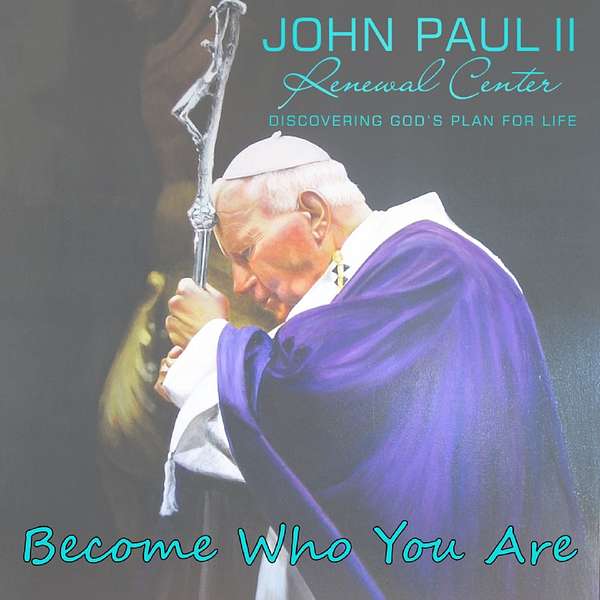
Become Who You Are
What’s the meaning and purpose of my life? What is my true identity? Why were we created male and female? How do I find happiness, joy and peace? How do I find love that lasts, forever? These are the timeless questions of the human heart. Join Jack Rigert and his guests for lively insights, reading the signs of our times through the lens of Catholic Teaching and the insights of Saint John Paul ll to guide us.
Saint Catherine of Siena said "Become who you are and you would set the world on fire".
Become Who You Are
#697 Charity Without Illusion: Immigration, Prudence, and the Christian Memory
Love to hear from you; “Send us a Text Message”
Headlines shout about border crises while our feeds trade compassion for outrage, but the deeper question remains: how do we love the stranger without surrendering the order that protects the weak?
Jack takes a hard look at the images and ideas shaping public imagination, starting with the Holy Family’s flight into Egypt and what it actually means for modern immigration debates. Egypt was a Roman province, not an alien nation; the story teaches refuge from a tyrant, not a mandate for lawlessness or open borders.
Drawing on St. John Paul II’s distinction between emigrants and immigrants, we examine how language quietly shifts blame from failed regimes that expel people to host nations struggling to respond. Borders exist to serve justice, not to erase it; ordered hospitality protects both citizens and newcomers.
The goal is a community able to welcome the stranger while preserving the very foundations that make welcome possible—family, faith‑shaped virtues, and the common good.
Read Jack's Article: Charity Without Illusion: Immigration, Prudence, and the Christian Memory
If this conversation challenged you or clarified something you’ve felt but couldn’t name, share it with a friend, subscribe for more, and leave a review with the one question you want us to tackle next.
I wrote an article for Crisis Magazine on immigration because I saw that the language, the imagery being used by the leadership within the Catholic Church concerning immigration are being highly distorted. And I want to address that article on today's show because the bishops at the USCCB, the United States Council of Catholic Bishops, are meeting with President Trump and his team. So for our regular audience, know that I'm addressing them as well as pastors, but also your neighbors and friends trying to make sense of what's going on in Minneapolis and Oregon and all these protests, right, that you see all over the place. And I'm not going to get into the nefarious aspects of all of this stuff. I've done that plenty of times. I want to really address this as a kind of a common sense, but also maybe a quasi-academic piece that we can all understand. And so, again, for our regular audience, know that I'm addressing them, pastors, neighbors, family, they're trying to make sense of all this. So feel free to share this with them. You know, sometimes these can be pretty contentious uh discussions that you're having. And we're trying to make sense of all this. They abuse the the uh not only the image of the Holy Family, which I'm gonna get into for a minute, but they abuse our language, twisting and distorting it. So I'm gonna just try to share the facts so that you can share this with people to clarify teaching, especially Catholic teaching on these issues. You know, know this that these subjects are not always easy to talk about, but the Catholic Church, this is not its first rodeo. And so we're blessed by what's called Catholic social teaching that's been passed down to us and it and it's refined as new circumstances are confronted. But we don't just throw out the baby with the bathwater. We always start, right? Marriage and the family, Christ and the church, and then we build on the culture and we build on the rest of Catholic social teaching. And, you know, how do we treat the immigrant and and all these different issues that they come up, right? So what I suggest is if you have these discussions, and and and we should be having these discussions, because we need to clarify this. There at the border, the the sex trafficking, the crimes, et cetera, et cetera. So there's a real need for this. And uh, and and unfortunately, the innocent always get caught up in this. Uh the first letter of John, which is one of my favorites, as you know, is uh talks about the sin of lawlessness. The sin of lawlessness. You know, when you don't have laws and an understanding and a basic foundation, you're just opinions getting blown around by the spirit of the age. So uh, anyways, as I go on here, the article, the title for the uh the show and the title for the article, which I will link in the show notes, so you can either uh um share the the article itself or the podcast, you know, or or both. And so let's you know, let's start to put a base underneath all this stuff so it's not all yelling and screaming. There's a lot there's a battle between uh what's true, what's good, and what's beautiful, and all the lies, the distortion, the evil, and the profanity, the to profane the beautiful happening all over the place, isn't there? And so we need to scroll back once in a while and say, you know, what makes sense? You know, what what how do I use my prudence? And uh you're gonna hear the word prudence. Prudence is a way to discern this, you know, look at the problem and say, you know, how does this all fit together? God gave us uh prudence, you know, a way to to you know, use our intellect and our reason to figure these things out and to move forward and always in prayer, always in prayer, right? So again, the title for today's show is Charity Without Illusion, Immigration, Prudence, and the Christian Memory. And I want to say uh Happy New Year once again. We're not that far into it. And as we enter into 2026, we find ourselves once again confronting questions that refuse to remain theoretical. Questions about borders, belonging, compassion, responsibility, charity, and political order. Immigration will continue to press itself upon public life, church teaching, and the Christian conscience, often framed in stark moral absolutes. Listen to that, often framed in stark moral absolutes that live leave little room for prudence or historical memory. It's therefore worth beginning the year by examining one of the most frequently invoked and most frequently misunderstood Christian images in this debate, and that's the flight of the Holy Family into Egypt. You know, I see this, and I'm not going to name names because I don't want to get into all that now. I want you to be able to share this, but using the Holy Family and showing that image and say, yeah, we just have to have open borders and chaos. Well, of course, you know, chaos, the sin of lawlessness. You can't have that. So the image of the Holy Family is frequently invoked in modern immigration debates. It's often presented as the definitive Christian archetype of the refugee family, one that allegedly demands unconditional welcome and suspension of prudential judgment. Yet the sentimental reading collapses under historical scrutiny and in doing so distorts the moral tradition it claims to defend. At the time, now this is very, very important. So sit back, listen to this for real carefully. Grab your coffee, have a sip. At the time of Christ's birth, Egypt was not a foreign nation. It wasn't a foreign nation state like people think, but it was a province of the of the Roman Empire. It was the next in 30 BC, 30 years before Jesus. Joseph and the Holy Family did not cross into an alien political order governed by unfamiliar laws and customs. He traveled within the same imperial jurisdiction that encompassed Judea, where he fled from. The Holy Family fled at a local tyrant, Herod, not a civilization. They did not breach borders, they did not demand accommodations, or seek to refashion Egyptian society. Very, very important here. They were displaced persons seeking safety, not symbols for ideological abstraction. The persistent misuse of this episode reveals a deeper confusion in contemporary Christian discourse on immigration, a confusion that John Paul II identified decades ago and one that remains unsolved. In his 1995 message for World Migration Day, addressing undocumented migrants, John Paul II observed a subtle but consequential shift in public language. Increasingly, society spoke of immigrants as problems within the host countries rather than of emigrants with an E. So think about this. So immigrants, increasingly, society spoke of immigrants with an I as problems within the host nation, like these are the problems in Minnesota within the United States, rather than of emigrants, immigrants, I should almost say, with an E, I wish they would have defined these words differently, driven. Now with immigrants with an E are driven from their homelands. So where did those people come from and why did they come here? By war, corruption, economic collapse, or political disorder, we should be focusing on that too. And John Paul said there's this shift in language that says we were ignoring where they came from and all the problems there that forced them as emigrants with an E to leave, to be emigrants with an I to come in. If you think about that, E is for exit emigrants, I is for for um for uh coming in, right? Flipping that language, taking the focus off of where they came from and what's going on there. In other words, these bishops, bishops, pastors, leaders within the church, you know, make sure that you don't just focus on the United States or in or Europe and say you're the bad guy because you don't just open all your borders. Don't twist and distort this language and this imagery. Make sure you're condemning, right? If you're going to condemn the host nation, make sure you're turning around and saying, hey, why did they leave? Otherwise, there's just, you know, everybody wants to uh uh flee like they did from Argentina. You know, one third of the population of Argentina fled. We need to be condemning that, you know, and I know there's bishops and cardinals on the ground in Argentina that did, but you think Pope you know Francis was helping? And and maybe I'll just throw this out as a question. You know, find everything that Pope Francis said condemning uh the you know the communists and the corruption and the and the drugs and stuff over there, you're not gonna find very, very much. He was very careful on his language, but yet he was open to what? Condemning the the the United States and and Europe for not opening the borders. There's reasons behind this, and they can be very nefarious. So again, let's just get down to what this means again. So again, I'm gonna repeat this because this is very, very important. The subtle changing of language, increasingly, societies, John Paul would talk about, uh, spoke of immigrants as problems within host nation, rather than emigrants with an E driven from their homelands for different reasons, right? And this inversion, he warned, conceals root causes while relocating blame. What is lost in this linguistic shift is moral clarity. As an emigrant with an E, it's a person compelled to leave his home because the conditions necessary for a stable and dignified life no longer exist. The primary moral failure in such cases lies within the regimes, elites, or systems that render life untenable. An immigrant with an I, by contrast, is that person viewed only from the perspective of the receiving nation, abstracted from the forces that expelled him. When public debate collapses the emigrant with an E into the immigrant with an I, attention is diverted from the injustices that drove displacement in the first place, and responsibility is subtly transferred to host countries or to the migrants themselves, instead of addressing the crisis that neither of them created in the first place. This confusion is further compounded when moral outrage is directed almost exclusively at receiving nations, often by church leaders and political movements shaped by socialist assumptions, while the failures of the sending nations go far go largely unexamined. Often Western countries are castigated for not absorbing ever greater numbers of migrants. You hear this over and over again, especially again in this last pontificate with Pope uh Francis, right? Open your borders, create chaos, you know. It was really uh poor teaching. At the very best, it was naive and poor teaching at the be at the best. And uh you you we can take it from there. I've talked about this again before. But today, I want to stay on this level, understand what I'm talking about here, right? So we're again, we can't just condemn uh Western uh uh countries for not absorbing ever ever greater numbers of migrants and not pay attention to the corruption, violence, economic mismanagement, or ideological decay that forced those families to abandon their homes in the first place. In such narratives, borders become the moral scandal. How much do we talk about the border crisis in the United States all this time and fighting about the border crisis without saying, hey, what's going on in those other countries? Because at least you can say start to say to our country, to our Western civilization, wow, you know, look look at how we are compared to them. And now be careful that we don't just become another third world country with no laws, just total corruption. And you know what? I better not get into that right now, you know. But you've heard me talk about that. That's exactly where our country was going, and this is where the battle is today. So John Paul's warning cuts directly against the imbalance. Authentic solidarity does not consist merely in redistributing populations, but in confronting and correcting the injustices that produce mass immigration with an E in the first place. To demand limitless reception, for example, from wealthier countries built upon Christian principles without demanding reform of the sending nations is not charity. It's a refusal to name responsibility. Importantly, John Paul II never endorsed the vision of open borders or moral indifference to political order. You hear that again? Should I repeat that? John Paul did not endorse a vision of open borders or moral indifference to political order. Catholic social teaching, again, is built on the human heart first. Marriage and the family, Christ and the church, united. Then we go out and we say, what is best for those people? What is best for our families, for religious uh uh um freedom in our country, et cetera, et cetera. What you see when you start to twist and distort the language, there's an attack on that base that will all crumble in. That's why it's so important, right? So John Paul uh repeatedly, consistently, repeatedly affirmed what? The inherent dignity of the human person, of all of us, every person, the ones fleeing, the ones coming, you know, into our country, the ones that say, hey, we've had enough. We can't deal with this anymore. All of those things are important, aren't they? And so we, you know, it's not like you know, it's us versus them because that's what the writer can be today. Um, you know, these are, you know, they're the people that were flooding across our border, it was tragic what was happening to them. The the the the amount of money that they had to pay the cartels, uh,$4,000 to$20,000 apiece, um, sex trafficking, rapes going on there, the drugs coming over. When you just open borders like that and and the NGOs taking this money, huh? And so again, when you start to talk about this, you have to remember the dignity though of those people being taken advantage of, caused by the open borders themselves. They wouldn't have been there without the open borders. Now, that doesn't make their life in those countries that are corrupt any better. But corrupting and distorting another country like that we had in this last administration, um, everything comes down, right? The whole moral order, the common good comes down. So again, we get to the dignity of the person. We always have to love the individual person while also upholding the right and the duty, this is from John Paul, of nations to regulate immigration, safeguard the common goods, which is what I was talking about, what's good for the citizens there. We have to think about that, and require respect for law, what they're they're not doing across these cities. Migrants, he insisted, possess rights, but they also bear responsibilities toward the societies that receive them. The tragedy of the modern debate lies in its insistence on choosing between compassion and prudence, as though uh fidelity to one required the abandonment of the other, right? It's not about choosing compassion or prudence, right? Like just throw out one. You know, no, they have to both come together. I have to be compassionate and prudent. And did you hear that again? You know, migrants have rights because they're human beings, but they also bear responsibilities toward those societies that receive them. When you have what's going on in Minneapolis, where you have this, these, these, uh, these immigrants coming into our country, and then what? They're not responsible for the country. You see the theft of billions of dollars, people that aren't working, people that are against the country, you know, and and so I don't want to get into that too deep right now because I just want you to be remembered all of that. Recovering this balance then that we're talking about requires returning to the church's tradition of moral realism. Moral realism. Let's begin with Saint Augustine. Saint Augustine, remember third, fourth century. So this is going back a long time. For Augustine, for Saint Augustine, peace is not merely the absence of violence, but order, that tranquility of order, he called it. Political authority exists to sustain a just framework within which truth may be sought, families may flourish, and communities may endure. When order dissolves, charity itself becomes incoherent, untethered from the social conditions that allow it to be exercised meaningfully. In the city of God, Saint Augustine wrote, he defends rulers who protect their people, arguing that legitimate authority restrains chaos and shields the innocent. Again, think about what's going on today. Whatever you think of Donald Trump when he closed those borders down and sought security there, all of a sudden, what? It restrained the chaos that was going on at the border. It shielded the innocent there. I want to make a real contrast just without getting into uh an argument on this, because again, I wanted you to use this podcast and this article to go out and share. So it's not about pometics here, right? It's it's saying use your prudence and compassion together. Take a step back and see what this is all about. So again, uh with St. Augustine, he he said, you know, rulers again need to protect their people, arguing again that legitimate authority restrains chaos and it shields the innocent. Think about 340,000 children brought over across the border that we lost in the country and what happened to them. I talked about that a lot in these in the past podcasts. If you want to see something really what happened to those kids, uh dig up that podcast I did with JJ Carroll that was on the border, ounding um, Attack on the Innocent. It was it's disgusting, actually. A society that abandons self-defense does not become more charitable, it becomes more fragile, inviting disorder that ultimately harms the weak most of all. Hospitality that corrodes order does not elevate mercy, it undermines it. St. Thomas Aquinas, Middle Ages, sharpens this insight with characteristic precision. Prudence, right? Prudence, you have to have common sense, right? Let's think through this. What is going on here? Teaches is right reason, your reason, which is seeking what? The truth, applied to action. What kind of action should I take? Again, thinking about the human person, also prudence, you know what's going on. The virtue that governs how so prudence is a virtue, a cardinal virtue. You got the theological virtues, faith, hope, and love, and then you got the cardinal virtues, and prudence is one of those four cardinal virtues. That's the future, uh the virtue that governs how universal principles such as love and justice are embodied in concrete circumstances. How do we apply these things? It has to work. Moral realism. Prudence is not fearfulness, nor is it moral retreat. It's wisdom and governance. Law, St. Thomas argues, must serve the common good rather than sentiment, you know, emotion, sentiment, impulse, abstraction. Isn't that what's going on today? He said, No, you got to use your prudence. Even charity itself follows an ordered logic. We owe particular responsibilities to those nearest to us. Think about that for a second. We owe particular responsibilities to those nearest to us. Think about a father with his with his children. My first responsibility is to my wife, my children, my relatives around me, my neighbors around me. And then it goes out. You know, I can't go out there when my family's being attacked, right? So So we have to be able to do that, you know. Uh prudence is not fearfulness. Again, he said, it's not retreating from this. And and again, it's charity itself flows from a uh from an ordered logic. And again, we owe responsibility, particular responsibility, starting with those nearest to us. And a country does the same thing. So for political leaders, what does this entail? It entails preserving social cohesion, public safety, the conditions necessary for a virtuous life. From this perspective, a nation must justly regulate its borders, limit inflows, require assimilation into that culture, and exclude genuine threats without betraying charity. Genuine threats. We're allowed gangs in here, violent gangs, provided such actions are undertaken without malice and respect for human dignity. Now think about this. You can look at ICE agents and say, well, you know, uh, you know, they're they're treating people poorly. They're going after criminals that are situated in the middle of these communities. And then you have the outside, these, you know, these crazy libs that have no idea what we're talking about here. That's why this type of uh a podcast and article, I thought was important, because we have to put framework back in here. You know, it's just not me yelling at some person without reason, without sense, without any prudence at all. You can't argue with these people. You have to do what's right. You have to go into those communities, though, and take out those people that came in that are going to be harming them. And unfortunately, when this twisting and abusive language, even coming from church leaders, it doesn't bring peace and order down. It drives more chaos. And some of them, unfortunately, do that on purpose. And we know this. We need clear teaching coming from the church. We are so sick, right, of all of this ambiguity, uh, confusion. And if you just throw up your hands and say, I guess the church doesn't know the truth. No, the church knows the truth. We just have to proclaim it and live it out. And again, it's it's about love, prudence, all those things, about discerning what's right. So this framework becomes unavoidable. Let's stretch it out a little bit when addressing Muslim immigration. Because when you start to talk about Muslim immigration, you know, oh, you're a hater, a bigoted. No, no, no. Let's again, let's use prudence, you know. Uh first of all, we're uh a nation where every single religion is here, every single people is here. It's the only country in the world that everybody came in here, but it's one nation under God. Why did it work? One nation under God. Our laws were set up on uh Judeo-Christian principles. There's no getting away from that. And when you just start to bring people from all different cultures that don't assimilate, don't agree to those laws, and you you get radical uh uh uh uh Muslims coming in, you see what's happening. You know, it's really something. So again, the framework becomes unavoidable. So, how do you do this? Addressing Muslim immigration into historically Christian societies. And this is what we're talking about in the Western culture. Christian caution in this regard does not arise from prejudice, but from memory. So when people say this, say, wait, wait, wait, wait, you have to use your memory, your prudence again. What happened and what has happened in history? Look, I have uh a very good friend of mine who's who's uh Muslim, and and he's a he's a good man. And he he's taken to the United States. Uh he's not trying to push Sharia law on us. Uh he doesn't beat his wife, you know. You know, you have to be very careful with this. So beginning, let's talk, let's go back a little bit in our memory. Beginning in the seventh century, Islamic conquest overwhelmed vast Christian heartlands across North Africa, the Levant and Asia Minor. Under their systems, Christians were often regulated to second class status through special taxation, restricted worship, diminished civil rights. Regions once exclusively Christian, listen to this, Egypt, Syria, Anatolia, did not drift into secular pluralism, just you know, slowly just get rid of God. No. They were subdued. These realities are not confined to history. Today, Christians remain the most persecuted religious group in the world, with a disportionate share of that persecution occurring in Muslim majority countries, blasphemy laws, uh forced conversions, church attacks, mob violence. Recent reports estimate more than 380 million Christians face high or extreme persecution globally. Christian moral reasoning demands careful distinction. And so remember that when people call you bigoted, hateful, just say, hey, are you kidding? Christians are the most persecuted group in the world. And you see that today. You saw that very strong with the Obama and the Biden administrations, right? Uh you see this even taught in schools that they were pushing down in the schools. Uh, this white shame. You know, it's amazing. The attack uh today in the United States is white Christian men and these guys growing up and they feel this pressure. I really feel for these young guys growing up. This is unjust. So Christian moral reasoning demands careful distinction. Systems and ideologies may conflict with Christian truth or with liberal political order, particularly where religion and law are inseparable, without imputing guilt to every single, and this is important to every single individual adherent. In other words, you we don't just throw Muslims all together. There are individual people that came from uh Muslim countries, uh persecuted, maybe, you know, corruption within you know, like in in Iran. A lot of them wanted to get out of there. They fled because of what was going on in Iran itself. You just see this oppression on people. And uh it and it's just another form of you think about Marxism, socialism, right? This taking away the voice of the people, this pression, this oppression down. You know, Christianity is such a different thing. It's opening up, isn't it? You know, here's Jesus Christ, take him into your heart and open up. We don't bring a small circle down and try to live in that circle. We open it up. Our freedom comes from God. We can be free to walk around the world, proclaim Jesus Christ in love, right? In truth, goodness, beauty, love. So Christian moral order and reasoning demands careful distinction against systems and ideologies may conflict with our with our truth or with liberal uh political order. You can particularly we're again where religion and law are inseparable. That's why we have uh uh um the the separation of church and state. Not that you take religion out of the culture. This is what the you know, what the Biden administration and the Obama administration tried to do, and and they weren't the only ones. And you see this all in our institutions, and I have to bring this up because you see this right now. No, if I'm Catholic, I can bring my Catholic faith, it's going to color what my actions in the world. And hopefully those are good actions because I'm a real Catholic and you know, someone who really believes in Jesus Christ, you know, not somebody swimming on the surface. That's why even articles like this, uh podcasts like this are very important to continue to inform uh Catholic's conscience, right? So we go out into the world and say, no, we we can have discussions about this. There are limits to immigration and to borders, and you can't just have chaos. And so we're not throwing everybody under the bus. You know, you you can't throw every Muslim under the bus because uh uh up in Minnesota, that uh uh Somali community and and others and complicit with them, you know. So it's not just the Somalis up there, uh, stole nine billion dollars of taxpayer money. I mean, it's disgusting. So collective uh suspicion of every Muslim person though would be unjust. So that's another beauty of Christianity and Catholic Catholic teaching. We don't just throw everybody under bus. We say, no, you stole. No, your community uh stole from us. You know, you guys are are not working, you're just taking off the welfare system. So you guys have to go back. You've already proven who you are. And this is the the crazy thing that's going on, say in Minnesota, when all these people have no idea uh or don't care, and they're just there to protect what? Corruption. How are they involved in corruption? Those are all things that I've talked about on podcasts before and will continue to do so. Because how can people protect that? How do they want that in their community? But they do. Uh politicians we know are looking for votes, etc., etc. So again, we don't throw everybody under the bus. Collective suspicion, again, of Muslim persons would be unjust, but informed caution shaped by historical experience is not bigotry. It is prudence. Returning once again to the Holy Family clarifies this matter. They fled danger, right, but posed no danger to anybody. They sought refuge, but they didn't demand cultural capitulation on the part of the people they came into. They lived quietly without imposing law on their hosts. To deploy their story as a rhetorical weapon against legitimate concerns about integration, extremism, or social cohesion is to misuse scripture itself. The gospel commands love of neighbor and love of stranger, but it never dissolves the responsibility of political stewardship. Scripture, John Paul II, St. Augustine, Saint Thomas Aquinas converge on demanding but coherent vision, right? Our God, the gospel is demanding, but it's coherent vision. The migrant is a person bearing inviolable uh dignity. That comes right from the U.S. uh Declaration of Independence, right? We have inalienable rights. The migrant comes in, he also has dignity built into him because he's a child of God. He's never a disposable burden that you can just get rid of, right? We have to look at this with prudence. But once you open this door to chaos, now we have to deal with the chaos. It's a mess. And so those people got hurt. Some of the good ones, you know, that came in, got hurt coming in, and now some of them will get caught up going back out the door again. Uh this is what happens when there's lawlessness. Sin causes lawlessness. And then you have to come in and do the best job you can cleaning up, right? But you can't just leave it alone. You can't let tax dollars go in, you can't continue this corruption because it grows like a cancer. So the nation is a moral community. It's not just an open in. Borders exist to serve justice, not to negate justice. Charity detached from truth, love detached from truth, erodes order. Prudence, severed from charity, hardens into cruelty. The Christian vocation refuses the false choice between compassion and security. To forget history is to invite this naive attitude that we all have, which will just create more confusion. To forget the person is to commit injustice. But if you forget prudence, you you you lose both, huh? You forget history and you you you commit injustices for people. We have to look at it all and realize what's going on, put it in the context of history, use our memory to see what's going on, see other nations and see what's going on. Um, but you have to defend your borders. The way forward lies neither in utopian universalism nor in defensive alarmism, you know, uh not just opening everything up and not just becoming, you know, we just have to close everything down forever. But we do have to wait until we get this under control again. But in societies capable, capable of welcoming the stranger while preserving their own moral and cultural foundations that made genuine hospitality and a chance for a better life possible in the first place. So let me end like that. I'll end with that statement. I'm going to repeat it again because it's important. The way forward lies neither in utopian universalism nor in defensive alarmism, but in societies like the United States capable of welcoming the stranger while preserving their own moral and cultural foundations that made genuine hospitalities and a chance for a better life possible in the first place. When you see the breakdown, like they are in the UK and Germany, those countries are declining very quickly. You have whole areas there now that are no-go zones where the immigrants came in, and now they're turning Germany, say or UK, into where what they came out of. That's why it's important. Why did you come out of there? You know, what was forcing you to come here? Are you just coming into as an invader or as an immigrant? Right? We have to ask those questions. We have to be able to ask those questions. We we made genuine hospitality, we made a place for people to come in, enjoy the American uh lifestyle to create a better chance for your family, for your future, you know, the American dream we call it. My grandparents came for the American dream. But we have to be able to uh offer them a better life by what? By keeping our standards up, right? To stay based on what made us great, which is again that Judeo-Christian foundation, the individual human heart that has that moral foundation built into it already. Marriage and a family, Christ and the church. That's your foundation. If you don't keep those and bring those out into the culture and then out into the way we look at the rest of the world, it's going to come down because that's what built us up. A lot of people don't care. If you care, then we have to hang on to what's true, good, and beautiful, especially the beauty of love. Hey, God bless you. Share this with your friends and neighbors. Don't forget to hit subscribe, uh hit the like button. And uh, you know, we we are dependent again on donors like you. So if you can financially support us, hey, goodbye, everyone.